


Facts, Misconceptions, and Safety Strategies
Energy storage systems are a crucial technology for transitioning to a sustainable energy future. With the growing integration of renewable sources like solar power, storage systems have become essential for ensuring a stable and continuous energy supply while preventing grid overloads.
However, the use of batteries—particularly lithium-ion batteries—has raised concerns about safety risks, such as fire hazards and explosions. But how much of this is true? What are the real risks associated with energy storage systems, and how can we mitigate them effectively?
How Do Energy Storage Systems Work?
Energy storage systems convert and store electrical energy using controlled electrochemical reactions. There are different types of storage systems:
- Low-voltage systems: Operate below 100V; capacity increases without affecting voltage.
- High-voltage systems: Series-connected modules increase overall voltage while maintaining current.
- Parallel systems: Connected modules increase output current.
- Series systems: Connected modules increase output voltage.
In all these systems, efficiency and security rely on the meticulous design of each system component, organized into several key elements:
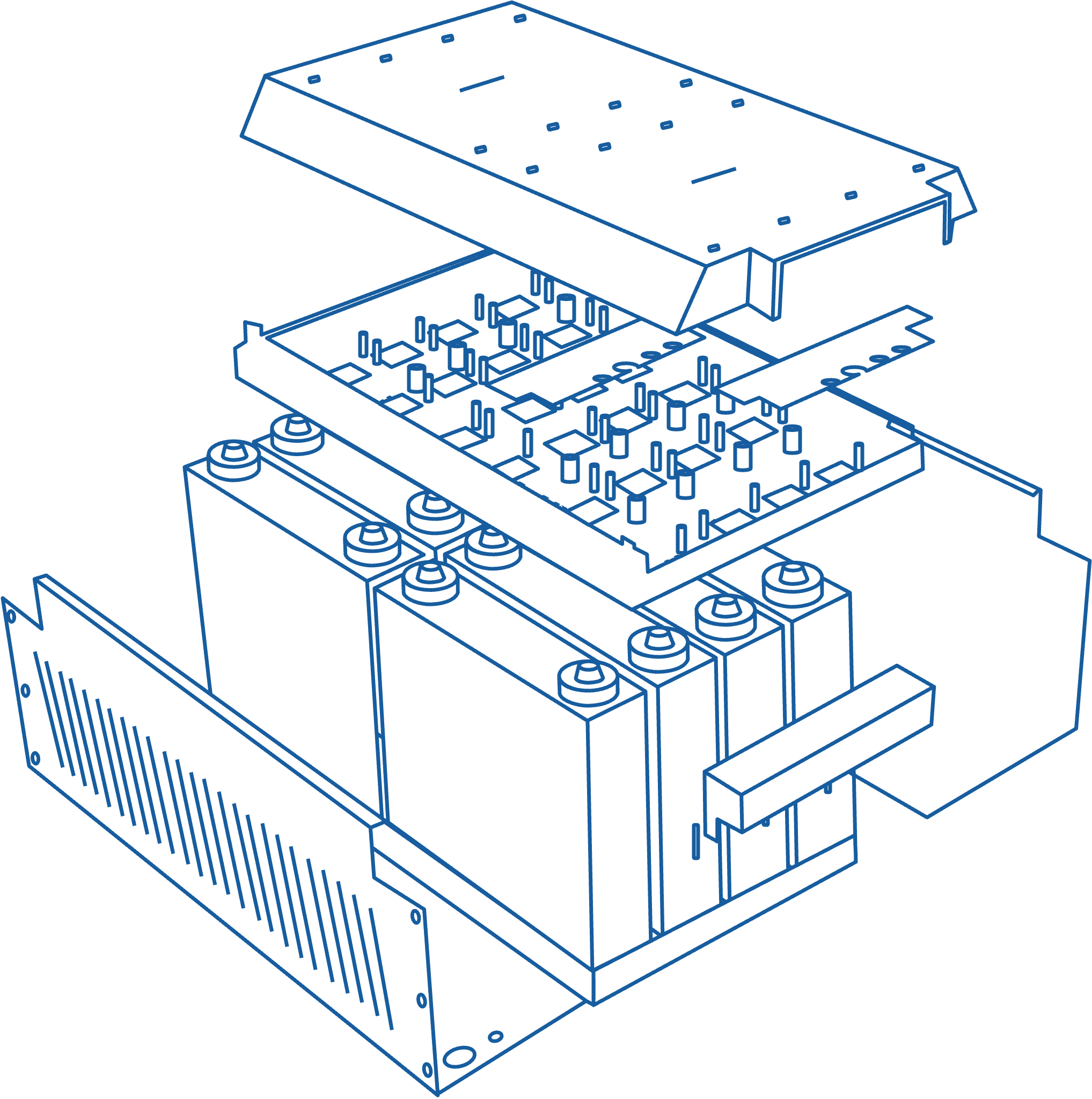
- Battery Cell: The fundamental unit of a battery, designed to store chemical energy and convert it into electrical energy through electrochemical reactions. Cells can come in cylindrical, prismatic, or pouch formats. The choice of cell type affects energy density, thermal management, and mechanical resilience. For example, prismatic cells offer a good balance between space efficiency and performance, while cylindrical cells, due to their shape, enhance heat dissipation—a crucial factor in high-temperature operating conditions.
- Battery Module
Battery packs, made up of multiple cells, form the core of the system.
- Battery Management System (BMS)
The BMS serves as the system’s operational brain, continuously monitoring key parameters such as temperature, voltage, and current for each cell. Using a dedicated algorithm, it balances the cells, prevents overcharging, and in some cases, can isolate faulty modules to prevent local issues from escalating into critical failures.
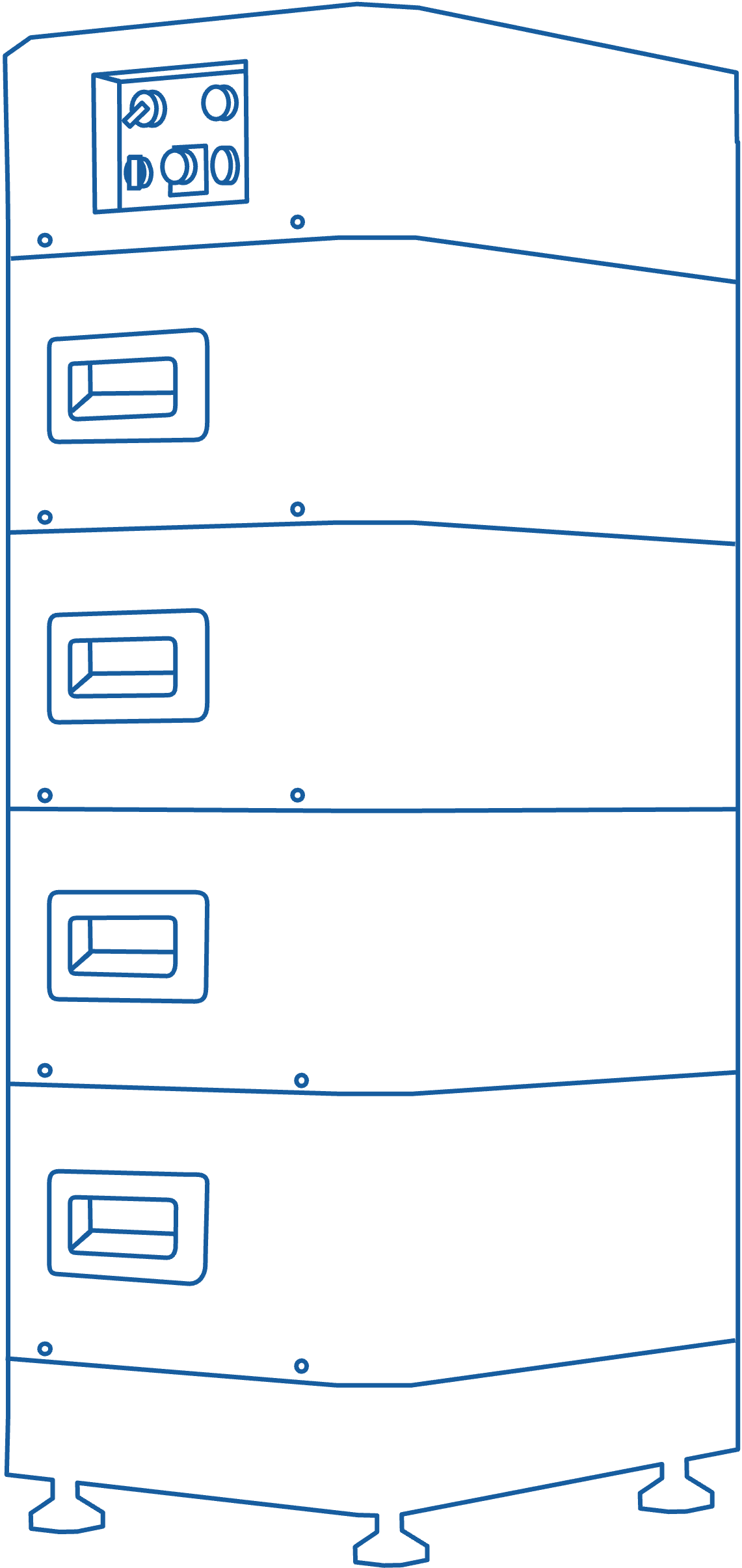
- Cooling and Thermal Management Systems
Some systems incorporate active cooling (forced air ventilation) or passive cooling (phase-change materials). These systems are designed to keep battery cells within optimal temperature ranges, even under peak load conditions.
Battery Cell Structure
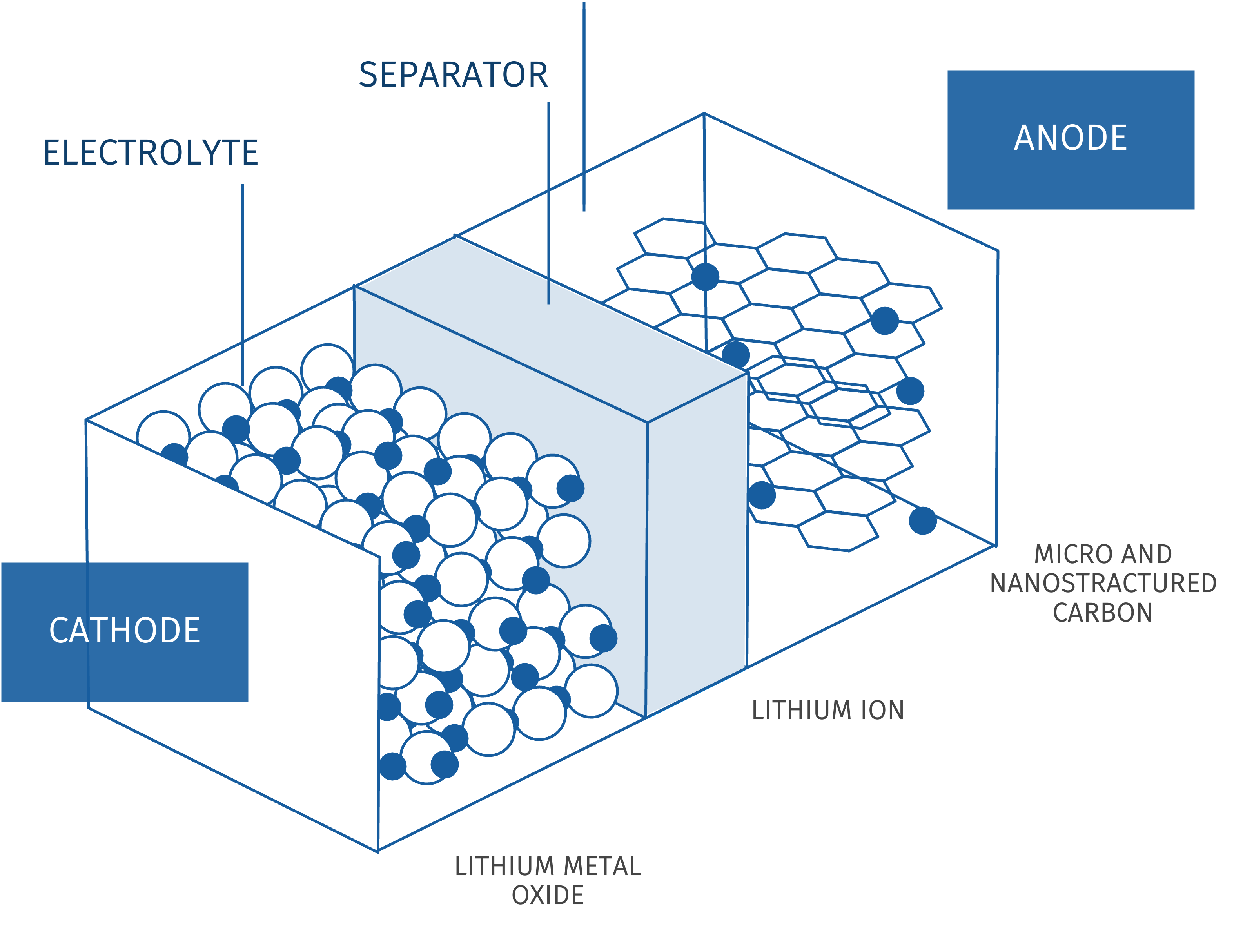
A battery cell is the fundamental unit of any battery and consists of several essential components:
- Electrodes:
- Anode (-): The negative terminal of the cell, where oxidation (electron release) occurs. It is made of nanostructured carbon-based materials, such as graphite.
- Cathode (+): The positive terminal of the cell, where reduction (electron acquisition) takes place. It can be composed of materials like metal oxides or rare-earth compounds, such as lithium iron phosphate.
- Electrolyte:
A chemical substance (liquid, solid, or gel) that facilitates ion movement between the anode and cathode, completing the internal circuit without allowing direct electrical contact. In lithium-ion batteries, the electrolyte is typically a lithium salt-based compound dissolved in organic solvents.
- Separator:
A thin, porous layer—usually made of polymer—that prevents direct contact between the anode and cathode, thus avoiding short circuits while allowing ions to pass through. It is commonly composed of polymeric materials like polyethylene or polypropylene.
- Current Collectors:
Metal plates or foils that gather electrons from the electrodes and transfer them to the external circuit.
- Case:
A sealed casing (plastic, aluminum, or steel) that protects internal components from moisture and prevents solvent evaporation.
All these components work together through electrochemical redox (oxidation-reduction) reactions, where electrons are transferred:
- An atom that loses electrons (gaining a positive charge) is oxidized and acts as the reducing agent.
- An atom that gains electrons (gaining a negative charge) is reduced and acts as the oxidizing agent.
How a Battery Works
- During Discharge (Supplying Energy)
- Electrons flow from the anode (-) to the cathode (+) through an external circuit, generating usable electricity.
- Positive ions (such as lithium ions, Li⁺) move through the electrolyte from the cathode to the anode to balance the electron flow and keep the reaction stable.
- This process converts stored chemical energy into electrical energy.
- During Charging (Storing Energy)
- Electrons are pushed in the opposite direction, from the cathode (+) to the anode (-), by an external power source.
- Positive ions migrate back through the electrolyte from the anode to the cathode, restoring the battery’s original chemical state.
- This converts electrical energy into chemical energy, storing it for future use.
This charge-discharge cycle repeats continuously, which is what makes rechargeable batteries like lithium-ion, lead-acid, and sodium-based batteries so useful.
Risks Associated with Battery Materials
Each component and material used in a battery presents specific risks. Here are the main concerns:
- Cathode:
Materials like NMC (nickel-manganese-cobalt) and LFP (lithium iron phosphate) determine a battery’s energy performance but come with different thermal stability challenges. NMC-based systems offer high energy density but require stricter thermal management, while LFP batteries, though slightly less energy-dense, provide greater inherent safety. - Electrolyte:
The volatility of the electrolyte is a critical safety factor. If the battery suffers structural damage or mechanical defects, the electrolyte can easily evaporate, releasing flammable gas mixtures that increase the risk of fire and explosion. Additionally, the precipitation of lithium salts can create highly reactive materials, further compounding the risk. - Separator:
While the separator itself is not inherently dangerous, it must withstand temperature and pressure fluctuations. If it fails and allows the anode and cathode to come into direct contact, it can lead to localized overheating and uncontrolled chemical reactions. - Anode:
The carbon-based anode is not highly flammable, but the presence of lithium ions makes it chemically unstable. Lithium readily reacts with moisture in the air, causing an exothermic (heat-producing) reaction that releases hydrogen gas, which is highly flammable.
In other words, the two most significant risks in batteries are:
- Lithium exposure to moisture, which generates heat and can act as an ignition source.
- Volatile organic solvents, which can serve as fuel in combustion scenarios.
These factors highlight the importance of proper battery design and safety mechanisms to minimize fire and explosion hazards.
Why Batteries Can Catch Fire
Battery fires can result from short circuits, manufacturing defects, physical damage, overcharging, or overheating. Here are the most common causes:
- Internal Short Circuit
- An internal short circuit occurs when the anode and cathode come into direct contact, often due to physical damage or manufacturing defects.
- This leads to an uncontrolled current flow, causing rapid overheating and potentially a fire.
- It can happen if a battery is crushed, punctured, or has a defective separator.
- Manufacturing Defects
- Faulty separators or metallic contaminants inside the battery can create internal short circuits or excessive heat buildup, increasing fire risk.
- Physical Damage
- A damaged battery may leak electrolyte, which is highly reactive.
- If the electrolyte comes into contact with moisture, it can trigger a fire or thermal reaction.
- Overcharging
- Charging a battery beyond its voltage limit (e.g., using an unregulated charger) can cause:
- Electrolyte breakdown,
- The release of flammable gases,
- Increased risk of thermal runaway (a dangerous self-sustaining overheating process).
The Most Critical Risk: Thermal Runaway
The most feared issue in lithium-based systems is overheating. If a cell overheats beyond a certain temperature, it can trigger a chain reaction known as thermal runaway:
- Excess heat causes uncontrolled chemical reactions in adjacent cells,
- This further raises the temperature,
Leading to uncontrollable battery destruction, and in extreme cases, fires or explosions.
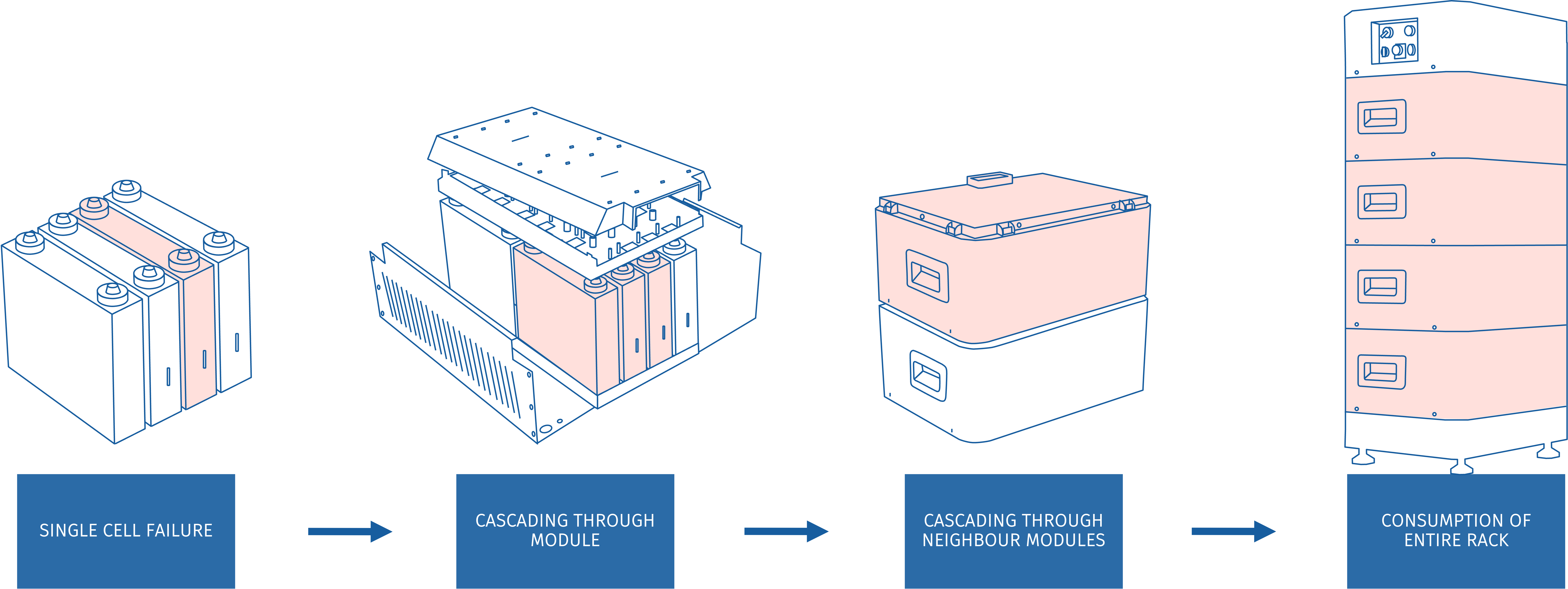
Fattori scatenanti del Runaway Termico:
- Mancanza di compartimentazione adeguata:
Se le singole celle e i moduli non vengono isolati in maniera adeguata, la propagazione del calore può avvenire in maniera molto più rapida. - Mancanza di un sistema di bilanciamento delle celle:
Pur lavorando in condizioni nominali, un sistema di accumulo può presentare sovraccarichi o sbilanciamenti di carica sulle singole celle. Questo fenomeno può essere evitato se è presente un sistema di bilanciamento autonomo delle celle nel singolo modulo batteria.
Come ridurre al minimo i rischi associati alle batterie
Il rischio di incendio nelle batterie utilizzate per i sistemi fotovoltaici residenziali e industriali di qualità e monitorati è molto basso. Tuttavia, data l’alta densità energetica di questi sistemi e la loro esposizione a cicli di carica/scarica prolungati, è fondamentale conoscere alcune strategie pratiche e misure di sicurezza per minimizzare il rischio:
- Progettazione di un sistema sicuro
- La scelta delle batterie giuste
Scegli batterie di alta qualità con certificazioni di sicurezza riconosciute (ad esempio, UL 1973, UL 9540A, IEC 62619 per sistemi di accumulo).
- Utilizzo di sistemi di gestione della batteria (BMS)
Un Battery Management System è essenziale per monitorare e controllare parametri critici della batteria, come:
- Tensione (evitare sovraccarico o scarica eccessiva).
- Corrente (limitare picchi anomali).
- Temperatura (spegnere il sistema in caso di surriscaldamento).
Assicurati che il BMS integri protezioni contro cortocircuiti, sovratensioni e runaway termico.
- Design modulare
Prediligi batterie modulari che isolano eventuali problemi in una singola unità senza propagarsi all’intero sistema.
- Gestione termica e prevenzione del surriscaldamento
- Controllo della temperatura esterna
Installa le batterie in ambienti freschi, ventilati e al riparo dalla luce solare diretta o da fonti di calore esterne. Se possibile, installare la batteria in un ambiente climatizzato a temperatura quanto più possibile costante.
- Posizionamento sicuro
Assicurati di installare il sistema di accumulo a una distanza adeguata dalle pareti, e da fonti di calore attive come altri macchinari o impianti (pompa di calore, radiatori, elettrodomestici)
- Monitoraggio continuo e manutenzione
- Monitoraggio remoto
Integra sistemi di monitoraggio in tempo reale che inviano notifiche in caso di anomalie (es. temperatura elevata, sovraccarico, scarica rapida).
- Manutenzione regolare
Controlla periodicamente lo stato delle batterie per segni di deterioramento, rigonfiamenti, perdite o collegamenti allentati. Esegui test diagnostici annuali per verificare l’integrità del sistema.
- Pulizia e ordine
Mantieni l’area intorno alle batterie pulita e priva di polvere o materiali infiammabili.
- Scelta della tecnologia di accumulo
- Opta per batterie con maggiore sicurezza intrinseca
Ad esempio, batterie al litio-ferro-fosfato (LiFePO₄), chimicamente più stabili rispetto alle batterie agli ioni di litio standard e con inferiore probabilità di runaway termico, o a sistemi certificati, che offrono una maggiore garanzia al rischio di eventi indesiderati.
- Installazione professionale e certificata
- Solo professionisti
Per l’installazione del tuo sistema, affidati solo a tecnici qualificati e in conformità con le normative locali e internazionali (es. norme CEI per l’Italia).
- Isolamento del sistema:
Installa interruttori di protezione contro cortocircuiti e fusibili per isolare automaticamente le batterie in caso di guasti, e separa fisicamente il banco batterie da altri componenti elettrici o infiammabili.
- Progettazione antincendio:
Prevedi barriere ignifughe tra le batterie, soprattutto in sistemi su larga scala, e installa rilevatori di fumo o sistemi antincendio dedicati.
- Operatività sicura del sistema
- Evita il sovraccarico e la scarica profonda:
Il BMS dovrebbe poter limitare la carica al massimo dell’80-90% della capacità. Impedire la scarica sotto il 20%, può ridurre il degrado del sistema e ridurre il rischio di eventi indesiderati nel tempo.
- Evita carichi irregolari
Imposta il sistema in modo che cicli di carica/scarica non siano eccessivamente rapidi o frequenti, specialmente durante i picchi di domanda.
- Smaltimento sicuro e fine vita
- Smaltisci correttamente le batterie esauste
Batterie usurate o danneggiate devono essere smaltite presso centri di raccolta certificati per evitare cortocircuiti o incendi durante il trasporto o il deposito. In caso di segni di danneggiamento nelle batterie del tuo sistema, affidati sempre a professionisti per il sopralluogo e la gestione.
- Riconosci i segnali di fine vita:
Se una batteria mostra segni di deterioramento (capacità ridotta, rigonfiamenti, perdite), sostituiscila immediatamente. Segnala sempre situazioni di rischio alle autorità locali (es. vigili del fuoco).


